
Bring Mcp Server
to VS Code Copilot
Create your Vinkius account to connect Runlayer to VS Code Copilot and start using all 27 AI tools in minutes. Fully managed, enterprise secure, and ready to use without writing a single line of code. No hosting, no server setup — just connect and start using.
 GDPR Free for Subscribers
Compatible with every major AI agent and IDE
 Gemini
What is the Runlayer MCP Server?
What you can do
Connect AI agents to the Runlayer Enterprise Control Plane for comprehensive MCP ecosystem management:
- Manage MCP Servers — register, inspect, update, and remove serverless MCP endpoints
- Manage Skills — create, assign, and version reusable agent capabilities
- Manage Agents — onboard AI agents (Claude, Cursor, VS Code, custom) with proper security guardrails
- Enforce Policies — define and audit security policies governing MCP access and agent permissions
- Audit Everything — retrieve complete audit trails of all MCP, skill, agent, and policy operations
- Manage API Keys — create, rotate, and revoke organization and personal API keys
- Run Security Scans — discover shadow AI, unauthorized MCP servers, and policy violations across your organization
- Monitor Organization Health — review member activity, server inventory, and security posture
How it works
- Generate an Organization API Key from Runlayer dashboard (Settings > API Keys)
- Configure your Runlayer host URL (your organization's Runlayer instance)
- Ask your AI agent to manage servers, enforce policies, audit logs, or discover shadow AI
- Natural language commands replace manual Runlayer dashboard operations
Who is this for?
Essential for IT security teams, AI governance officers, platform engineers, compliance managers, and enterprise architects deploying MCP at scale. Let AI agents handle continuous MCP server registration, policy enforcement, audit log review, API key rotation, and shadow AI discovery. Perfect for organizations managing 10+ MCP servers and agents who need to maintain security compliance, prevent unauthorized AI usage, and enable AI-driven infrastructure governance.
Built-in capabilities (27)
Requires agent name and type (claude_desktop, cursor, vs_code, custom). Optionally assign MCP servers, skills, and policies during registration. Returns the created agent details. Use this to onboard new AI agents to your enterprise control plane with proper security guardrails. Register a new AI agent in Runlayer
Returns the key value (shown only once) and metadata. Use this to create keys for integrations, CI/CD pipelines, or service accounts. Store the key value securely immediately after creation. Create a new API key for your Runlayer organization
Requires server name and connection details (URL, authentication method). Optionally assign skills, agents, and policies during registration. Returns the created server details including the new UUID. Use this to onboard new MCP servers to your enterprise control plane. Register a new MCP server in Runlayer
Requires policy name and rule definitions. Returns the created policy. Use this to enforce security standards, restrict access to sensitive MCP servers, or define audit requirements. Create a new security or access policy in Runlayer
Requires skill name and description. Optionally define input/output schemas and initial MCP server assignments. Returns the created skill details. Use this to codify reusable agent capabilities for consistent use across your organization. Register a new skill (agent capability) in Runlayer
This disconnects the agent from all MCP servers and removes policy assignments. Requires the agent ID. Confirm with the user before proceeding. Remove an AI agent from Runlayer
This action disconnects all associated agents and removes policy assignments. Requires the server UUID. Confirm with the user before proceeding. Remove an MCP server from Runlayer
All resources previously governed by this policy will no longer be subject to its rules. Requires the policy ID. Confirm with the user before proceeding. Remove a security or access policy from Runlayer
Does not delete the underlying MCP server tools. Requires the skill ID. Confirm with the user before proceeding. Remove a skill from Runlayer
Requires the agent ID from list_agents results. Use this to review agent configuration, audit access patterns, or troubleshoot connectivity. Get detailed information about a specific AI agent
Returns timestamps, actor identities, action types, affected resources, and outcomes. Use this for compliance reporting, security investigations, or operational troubleshooting. Get audit logs for your Runlayer organization
Requires the server UUID from list_mcp_servers results. Use this to review server configuration, verify security compliance, or troubleshoot connectivity issues. Get detailed information about a specific MCP server
Use this to verify your organization configuration or get an overview of your MCP ecosystem. Get your Runlayer organization details
Requires the scan ID from run_mcp_sweep_scan results. Use this to review shadow AI discoveries, identify policy violations, or generate compliance reports. Get results from an MCP sweep scan
Requires the skill ID from list_skills results. Use this to review skill configuration or understand capability dependencies. Get detailed information about a specific skill
Returns agent names, IDs, types (Claude Desktop, Cursor, custom), assigned MCP servers, active skills, policy compliance status, and last activity timestamps. Use this to understand your agent ecosystem and verify which agents have access to which MCP servers. List all AI agents registered in your Runlayer organization
Use this to audit key inventory, identify unused keys, or prepare for key rotation. List all API keys for your Runlayer organization
Returns server names, UUIDs, status (active, inactive, blocked), assigned skills, connected agents, policy associations, and last activity timestamps. Use this as the first step to understand your MCP server inventory before managing individual servers, applying policies, or reviewing security posture. List all registered MCP servers in your Runlayer organization
Use this to audit access, review role assignments, or identify inactive accounts. List all members of your Runlayer organization
Returns policy names, descriptions, enforcement status, affected resources, and violation counts. Use this to review your security posture before creating or modifying policies. List all security and access policies in your Runlayer organization
Returns skill names, descriptions, associated MCP servers, usage counts, and version information. Use this to discover available capabilities before assigning them to agents or MCP servers. List all skills registered in your Runlayer organization
This action cannot be undone. Requires the key ID. Use this for compromised keys, unused keys, or during security incidents. Revoke an API key immediately
Returns a scan ID which can be used with get_scan_results to retrieve findings. Use this for security assessments, compliance audits, or shadow AI detection. Run an MCP sweep scan to discover shadow AI across your organization
Only pass the fields you want to change. Requires the agent ID. Use this to update agent assignments or modify metadata. Update an existing AI agent configuration
Only pass the fields you want to change. Requires the server UUID. Use this to update server endpoints, rotate credentials, or modify policy assignments. Update an existing MCP server configuration
Only pass the fields you want to change. Requires the policy ID. Use this to refine security requirements, update access controls, or modify audit rules. Update an existing security or access policy
Only pass the fields you want to change. Requires the skill ID. Use this to refine skill definitions or update documentation. Update an existing skill configuration
Why VS Code Copilot?
GitHub Copilot Agent mode brings Runlayer data directly into your VS Code workflow. With a project-scoped config, the entire team shares access to 27 tools. Copilot queries live data, generates typed code, and writes tests from actual API responses, all without leaving the editor.
- —
VS Code is used by over 70% of developers. adding MCP tools to Copilot means your team can leverage external data without leaving their primary editor
- —
Project-scoped MCP configs (
.vscode/mcp.json) let you commit server configurations to your repository, ensuring the entire team shares the same tool access - —
Copilot's Agent mode integrates MCP tools seamlessly with file editing, terminal commands, and workspace search in a single agentic loop
- —
GitHub's enterprise compliance and audit features extend to MCP tool usage, providing visibility into how AI interacts with external services
Runlayer in VS Code Copilot
Why run Runlayer with Vinkius?
The Runlayer connection runs on our fully managed, secure cloud infrastructure. We handle the hosting, maintenance, and security so you don't have to deal with servers or code. All 27 tools are ready to work instantly without any complex setup.
You stay in complete control of your data. Your AI only accesses the information you approve, keeping your sensitive passwords and private details completely safe. Plus, with automatic optimizations, your AI works faster and more efficiently.
* Every connection is hosted and maintained by Vinkius. We handle the security, updates, and infrastructure so you don't have to write code or manage servers. See our infrastructure
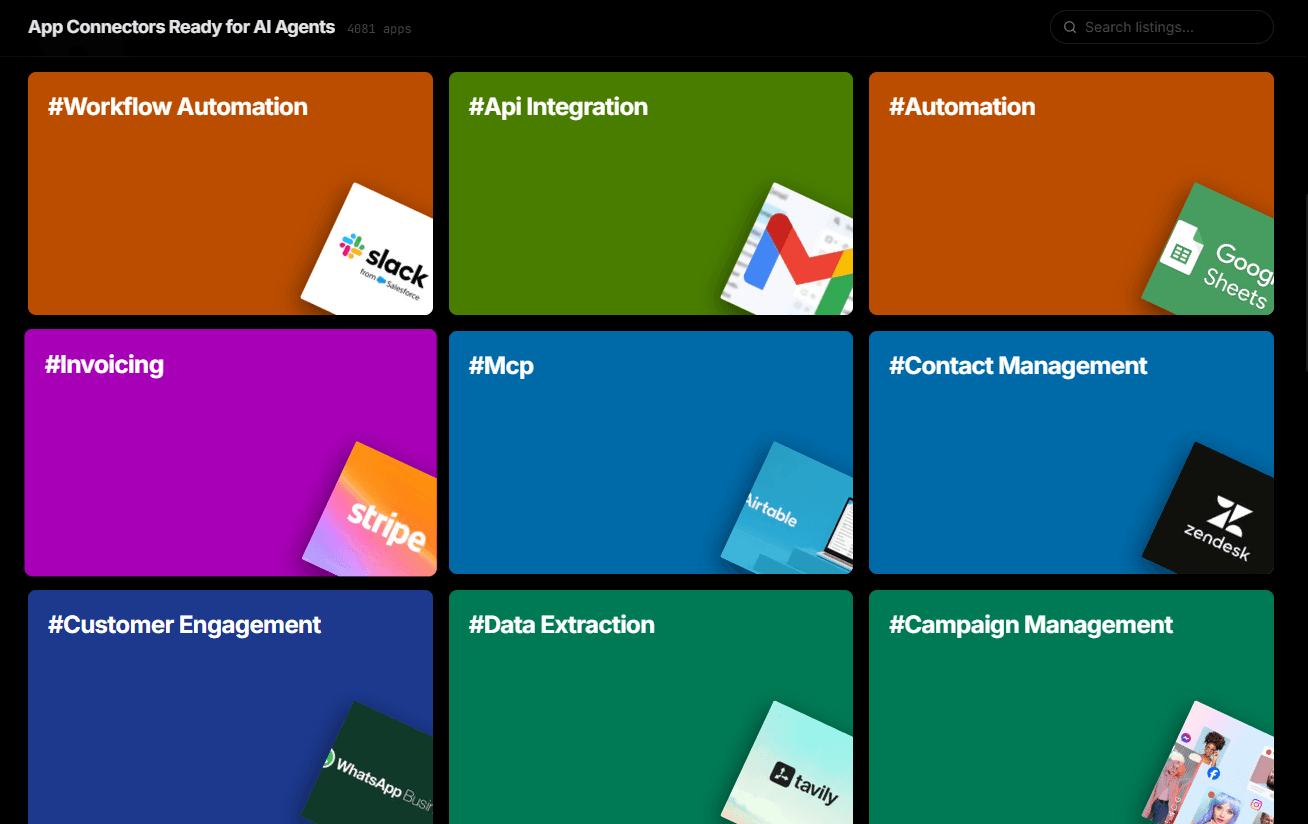
Over 4,000 integrations ready for AI agents
Explore a vast library of pre-built integrations, optimized and ready to deploy.
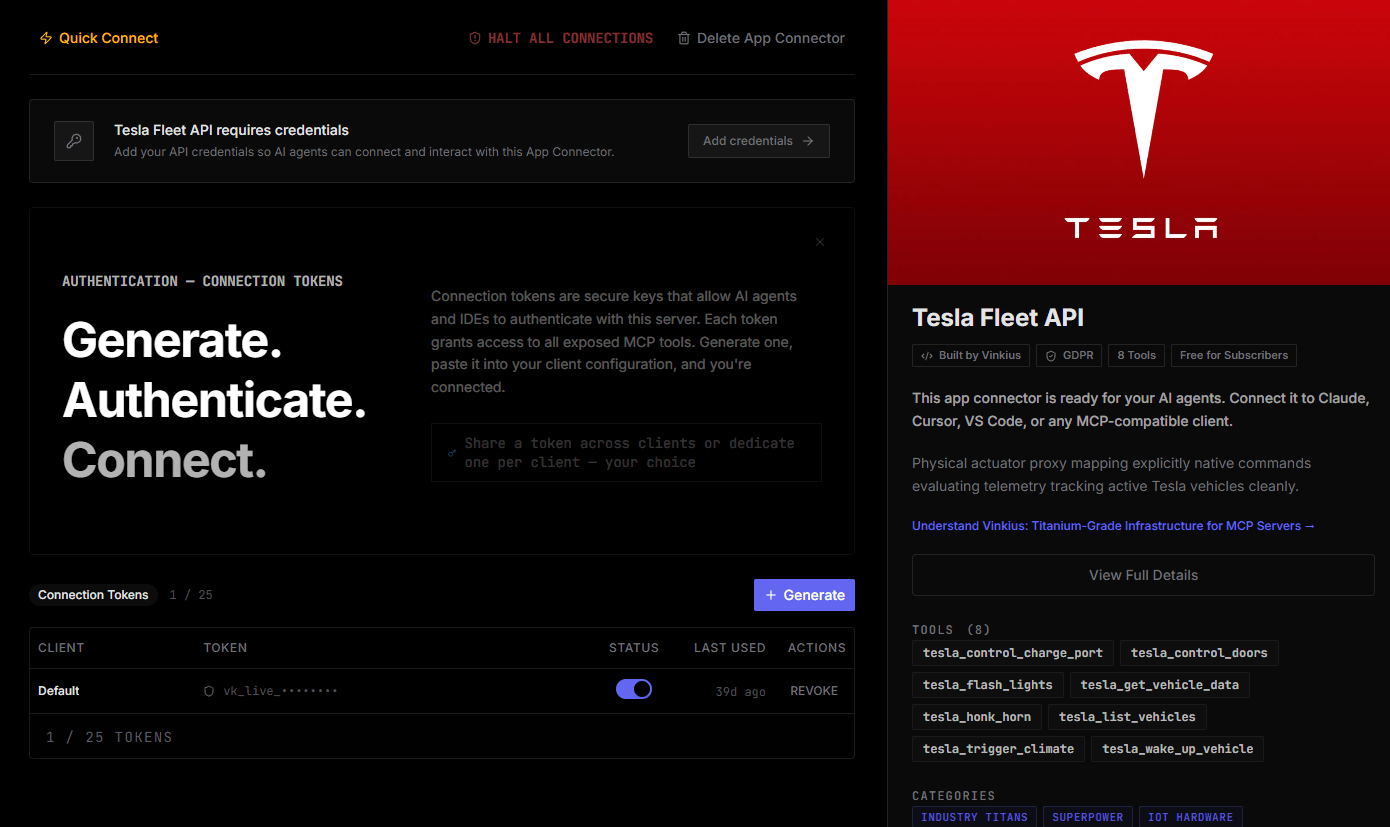
Connect securely in under 30 seconds
Generate tokens to authenticate and link external services in a single step.
Complete visibility into every agent action
Audit live requests, latency, success rates, and active security compliance policies.
Optimize spending and track token ROI
Analyze real-time token consumption and cost metrics detailed by connection.
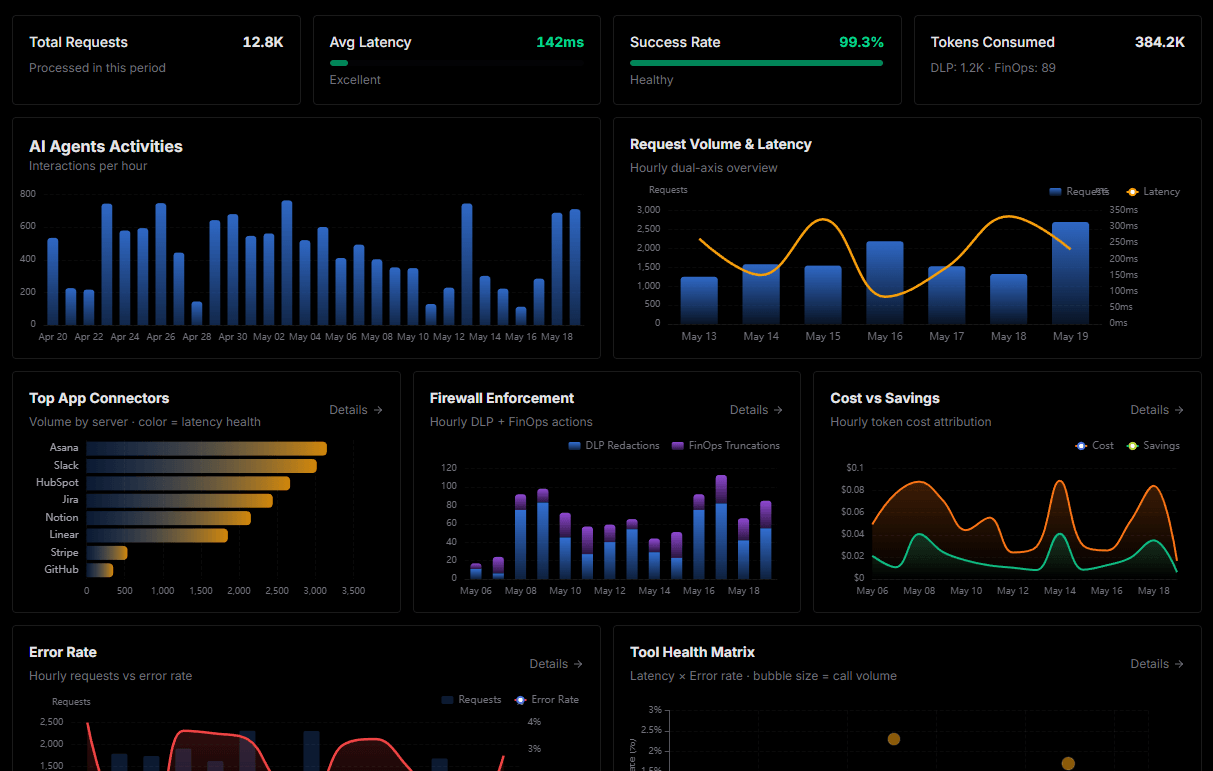
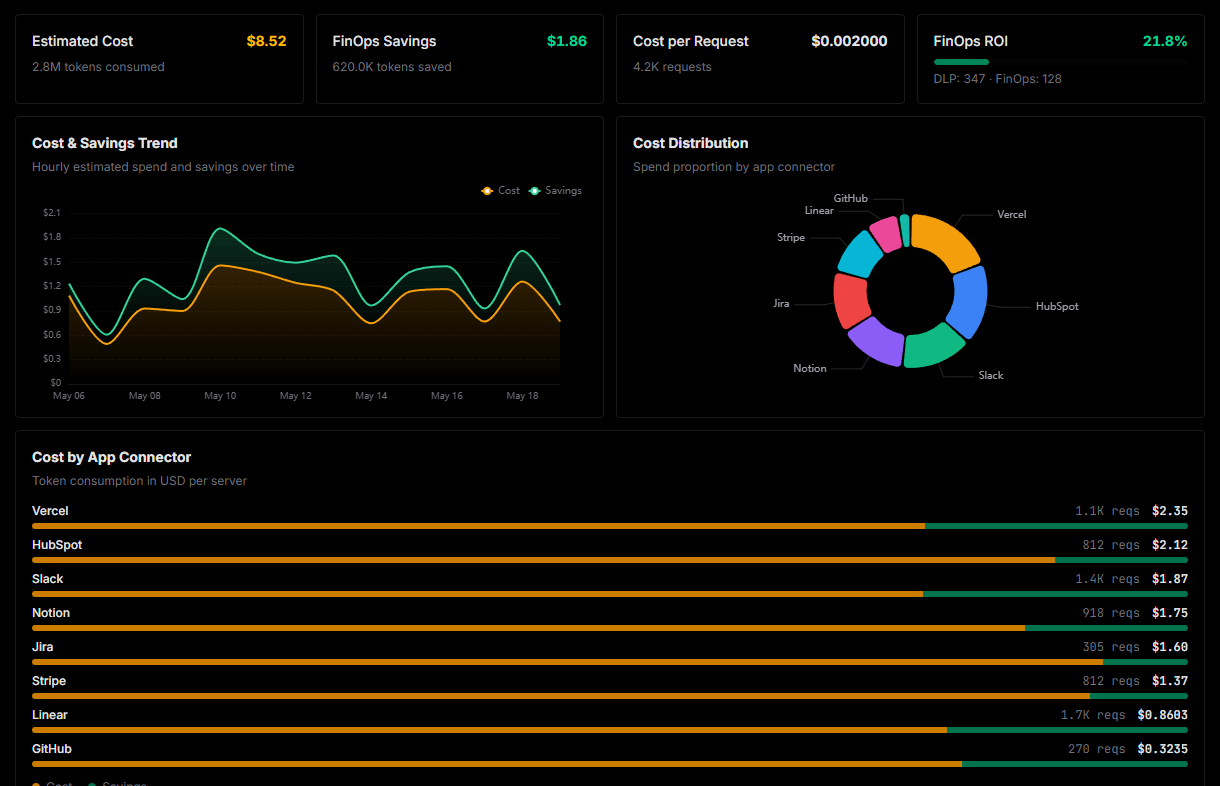
Explore our live AI Agents Analytics dashboard to see it all working
This dashboard is included when you connect Runlayer using Vinkius. You will never be left in the dark about what your AI agents are doing with your tools.
Runlayer and 4,000+ other AI tools. No hosting, no code, ready to use.
Professionals who connect Runlayer to VS Code Copilot through Vinkius don't need to write code, manage servers, or worry about security. Everything is pre-configured, secure, and runs automatically in the background.
Raw MCP | Vinkius | |
|---|---|---|
| Ready-to-use MCPs | Find and configure each manually | 4,000+ MCPs ready to use |
| Connection Setup | Manual coding & server setup | 1-click instant connection |
| Server Hosting | You host it yourself (needs 24/7 uptime) | 100% hosted & managed by Vinkius |
| Security & Privacy | Stored in plaintext config files | Bank-grade encrypted vault |
| Activity Visibility | Blind execution (no logs or tracking) | Live dashboard with real-time logs |
| Cost Control | Runaway AI token spend risk | Automatic budget limits |
| Revoking Access | Must delete files or code to stop | 1-click disconnect button |
How Vinkius secures
Runlayer for VS Code Copilot
Every request between VS Code Copilot and Runlayer is protected by our secure gateway. We automatically keep your sensitive data private, prevent unauthorized access, and let you disconnect instantly at any time.
Frequently asked questions
Do I need a Runlayer enterprise subscription to use this MCP?
Yes, this MCP server requires an active Runlayer organization with API access. Runlayer is an enterprise-grade control plane, so you need a valid organizational subscription. Contact Runlayer sales to get started and obtain your organization API key.
Can this MCP server detect unauthorized AI usage (shadow AI)?
Yes! The run_mcp_sweep_scan tool initiates comprehensive shadow AI discovery across devices, detecting unauthorized MCP servers, OpenClaw installs, Skills, and agents. Results include policy violations and security risks across your organization's endpoints.
What types of AI agents does Runlayer support?
Runlayer supports Claude Desktop, Cursor, VS Code with Copilot, Windsurf, and custom AI agents. Each agent type can be registered with specific security policies, assigned MCP servers, and monitored through the audit trail. New agent types can be added as custom integrations.
Which VS Code version supports MCP?
MCP support requires VS Code 1.99 or later with the GitHub Copilot extension. Ensure both are updated to the latest version. Older versions of Copilot may not expose the Agent mode toggle.
How do I switch to Agent mode?
Open the Copilot Chat panel and look for two mode options: "Ask" and "Agent". Click "Agent" to enable autonomous tool calling. In Ask mode, Copilot provides conversational answers but cannot invoke MCP tools.
Can I restrict which MCP tools Copilot can access?
Yes. VS Code shows a tool consent dialog before any MCP tool is invoked for the first time. You can also configure tool access policies at the organization level through GitHub Copilot settings.
Does MCP work in VS Code Remote or Codespaces?
Yes. MCP servers configured via .vscode/mcp.json work in Remote SSH, WSL, and GitHub Codespaces environments. The MCP connection is established from the remote host, so ensure the server URL is accessible from that environment.
MCP tools not available
Ensure you are in Agent mode in Copilot Chat. MCP tools only appear in Agent mode.
Explore More MCP Servers
View all →
Bear
10 toolsManage your Bear notes via AI — search, create, and organize your markdown knowledge base autonomously.

ClubPlanner
12 toolsManage fitness club memberships, class bookings, and member check-ins with tools designed for health and wellness businesses.

crowd.dev (LFX CDP)
10 toolsEquip your AI agent to manage community members, activities, and organizations directly via the crowd.dev (LFX) API.

TYPO3 CMS
10 toolsAutomate content management via TYPO3 CMS — retrieve page structures, create Extbase entities, update fields, and audit configurations seamlessly.