
EBI Proteins API MCP Server for CursorGive Cursor instant access to 16 tools to Get Antigen, Get Coordinates, Get Genecentric, and more
 GDPR Free for Subscribers
Cursor is an AI-first code editor built on VS Code that integrates LLM-powered coding assistance directly into the development workflow. Its Agent mode enables autonomous multi-step coding tasks, and MCP support lets agents access external data sources and APIs during code generation.
Ask AI about this MCP Server for Cursor
The EBI Proteins API MCP Server for Cursor is a standout in the The Unthinkable category — giving your AI agent 16 tools to work with, ready to go from day one.
Vinkius delivers Streamable HTTP and SSE to any MCP client
 Gemini
{
"mcpServers": {
"ebi-proteins-api": {
"url": "https://edge.vinkius.com/[YOUR_TOKEN_HERE]/mcp"
}
}
}Vinkius Desktop App
The modern way to manage MCP Servers — no config files, no terminal commands. Install EBI Proteins API and 4,000+ MCP Servers from a single visual interface.
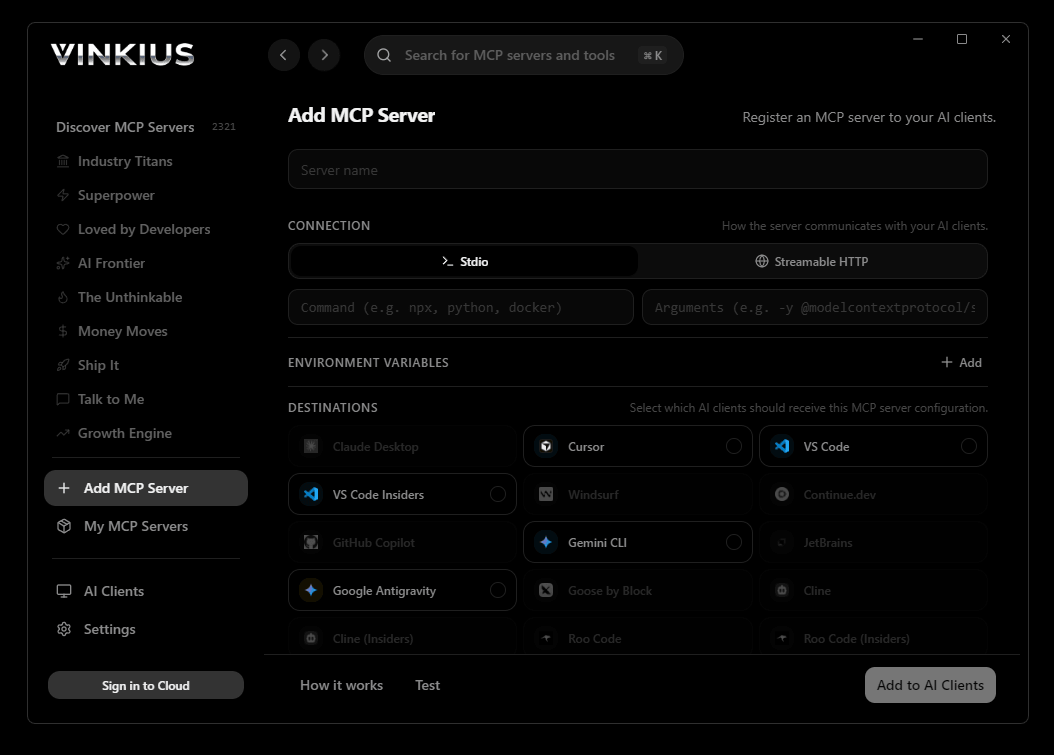

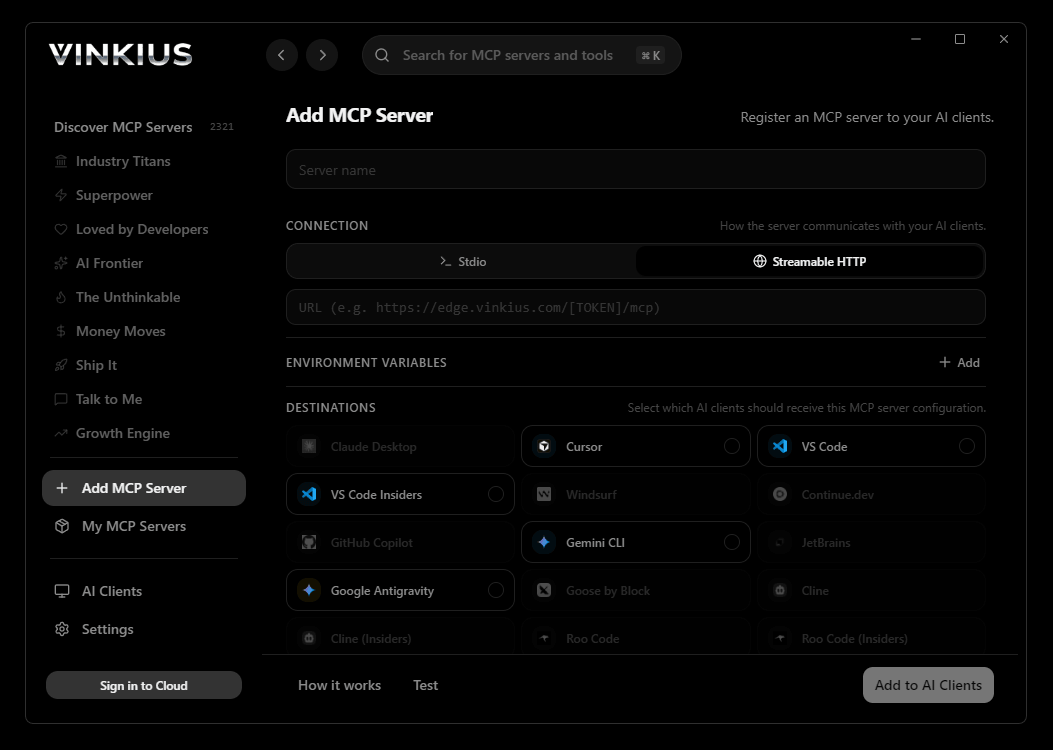

* Every MCP server runs on Vinkius-managed infrastructure inside AWS - a purpose-built runtime with per-request V8 isolates, Ed25519 signed audit chains, and sub-40ms cold starts optimized for native MCP execution. See our infrastructure
About EBI Proteins API MCP Server
Connect to the EMBL-EBI Proteins API and access comprehensive protein biology data from one of the world's leading bioinformatics institutes.
Cursor's Agent mode turns EBI Proteins API into an in-editor superpower. Ask Cursor to generate code using live data from EBI Proteins API and it fetches, processes, and writes. all in a single agentic loop. 16 tools appear alongside file editing and terminal access, creating a unified development environment grounded in real-time information.
What you can do
- Protein Retrieval — Fetch complete protein entries by UniProt accession with names, organisms, gene information, sequences, and cross-references
- Sequence Features — Retrieve annotated domains, binding sites, active sites, signal peptides, transmembrane regions, and disulfide bonds for any protein
- Genetic Variants — Access curated variants from UniProtKB aggregated with large-scale studies including ClinVar, gnomAD, 1000 Genomes, COSMIC, and TOPMed
- Proteomics & PTMs — Query mass-spectrometry peptide evidence and post-translational modifications from PeptideAtlas, MaxQB, EPD, and ProteomicsDB
- Mutagenesis — Explore curated mutagenesis experiments with detailed phenotypic effect descriptions
- Proteomes & Taxonomy — Search reference proteomes and navigate the taxonomy tree by ID or organism name
- Genome Coordinates — Map proteins to genome positions on GRCh38/GRCh37 with Ensembl gene, transcript, and translation IDs
The EBI Proteins API MCP Server exposes 16 tools through the Vinkius. Connect it to Cursor in under two minutes — credentials fully managed, no infrastructure to provision, no vendor lock-in. Your configuration, your data, your control.
All 16 EBI Proteins API tools available for Cursor
When Cursor connects to EBI Proteins API through Vinkius, your AI agent gets direct access to every tool listed below — spanning proteins, uniprot, bioinformatics, and more. Every call runs in a secure, isolated environment with full audit visibility. Beyond a simple connection, you get real-time monitoring of agent activity, enterprise governance, and optimized token usage.
Get antigen on EBI Proteins API
These are peptide regions used for antibody generation, indicating experimentally validated protein expression targets. Useful for immunology and antibody-based research. Get antigen sequences from Human Protein Atlas
Get coordinates on EBI Proteins API
Returns Ensembl gene, transcript, and translation IDs along with chromosome, start/end positions, and strand information. Essential for bridging protein annotations with genomic data. Get genome coordinate mappings for a protein
Get genecentric on EBI Proteins API
Shows canonical protein and related protein count for each gene. Use with a UniProt Proteome ID (e.g. UP000005640). Get the gene-centric view of a proteome
Get mutagenesis on EBI Proteins API
Each entry includes the wild-type and mutant residues, position, and a description of the functional impact. Critical for understanding structure-function relationships. Get mutagenesis experiments and phenotypic effects
Get protein on EBI Proteins API
Use a UniProt accession such as P12345, Q9Y6K9, or P53_HUMAN. Retrieve a full protein entry by UniProt accession
Get protein features on EBI Proteins API
Features include domains, binding sites, active sites, signal peptides, transmembrane regions, disulfide bonds, glycosylation sites, and more. Each feature has start/end positions and evidence counts. Get sequence feature annotations for a protein
Get proteome on EBI Proteins API
Returns taxonomy, protein count, gene count, reference status, and component information. Use IDs like UP000005640 for human proteome or UP000000589 for mouse. Get a specific proteome by UniProt Proteome ID
Get proteomics on EBI Proteins API
Shows which peptides have been experimentally detected and whether they are unique to this protein. Essential for validating protein expression. Get mass-spectrometry proteomics data for a protein
Get proteomics ptm on EBI Proteins API
Provides residue-level PTM positions with evidence counts. Get post-translational modifications from mass-spec data
Get taxonomy on EBI Proteins API
Returns scientific name, common name, rank, lineage, parent, and children nodes. Use IDs like 9606 for human, 10090 for mouse, 562 for E. coli. Get taxonomy node details by NCBI taxon ID
Get variation on EBI Proteins API
Each variant includes wild-type and mutant residues, clinical significance, consequence type (e.g. missense, nonsense), and cross-references. Critical for clinical genomics and variant interpretation. Get genetic variants for a protein from multiple sources
Search features by type on EBI Proteins API
Valid types include: DOMAIN, BINDING, ACTIVE_SITE, SIGNAL, TRANSMEM, DISULFID, CARBOHYD, MOD_RES, VARIANT, MUTAGEN, REGION, MOTIF, SITE, REPEAT, COILED, COMPBIAS, HELIX, STRAND, TURN. Search features by type across proteins
Search proteins on EBI Proteins API
You can combine gene name (e.g. TP53), organism (e.g. human, 9606), keyword (e.g. kinase), or accession. Returns a summarized list of matching proteins with names, organisms, and sequence lengths. Search proteins by gene name, organism, or keyword
Search proteomes on EBI Proteins API
Returns proteome IDs, taxonomy, protein counts, gene counts, and reference proteome status. Use queries like "homo sapiens", "escherichia coli", "arabidopsis". Search proteomes by organism name
Search taxonomy on EBI Proteins API
Returns matching taxonomy entries with scientific names, common names, taxon IDs, and ranks. Useful for finding the correct taxon ID before querying proteins or proteomes for a specific organism. Search taxonomy by organism name
Search variation on EBI Proteins API
g. large_scale_study, uniprot, mixed), consequence type (e.g. missense, stop gained), and wild-type residue. Use this to find clinically relevant variants across the proteome. Search variants by consequence type, source, or residue
Connect EBI Proteins API to Cursor via MCP
Follow these steps to wire EBI Proteins API into Cursor. The entire setup takes under two minutes — your credentials stay safe behind Vinkius.
Open MCP Settings
Cmd+Shift+P (macOS) or Ctrl+Shift+P (Windows/Linux) → search "MCP Settings"Add the server config
mcp.json file that opensSave the file
Start using EBI Proteins API
Why Use Cursor with the EBI Proteins API MCP Server
Cursor AI Code Editor provides unique advantages when paired with EBI Proteins API through the Model Context Protocol.
Agent mode turns Cursor into an autonomous coding assistant that can read files, run commands, and call MCP tools without switching context
Cursor's Composer feature can generate entire files using real-time data fetched through MCP. no copy-pasting from external dashboards
MCP tools appear alongside built-in tools like file reading and terminal access, creating a unified agentic environment
VS Code extension compatibility means your existing workflow, keybindings, and extensions all work alongside MCP tools
EBI Proteins API + Cursor Use Cases
Practical scenarios where Cursor combined with the EBI Proteins API MCP Server delivers measurable value.
Code generation with live data: ask Cursor to generate a security report module using live DNS and subdomain data fetched through MCP
Automated documentation: have Cursor query your API's tool schemas and generate TypeScript interfaces or OpenAPI specs automatically
Infrastructure-as-code: Cursor can fetch domain configurations and generate corresponding Terraform or CloudFormation templates
Test scaffolding: ask Cursor to pull real API responses via MCP and generate unit test fixtures from actual data
Example Prompts for EBI Proteins API in Cursor
Ready-to-use prompts you can give your Cursor agent to start working with EBI Proteins API immediately.
"Get all known genetic variants for the TP53 tumor suppressor protein."
"Show me the domain architecture and binding sites of the EGFR protein."
"Map the BRCA1 protein to its genome coordinates on GRCh38."
Troubleshooting EBI Proteins API MCP Server with Cursor
Common issues when connecting EBI Proteins API to Cursor through Vinkius, and how to resolve them.
Tools not appearing in Cursor
Server shows as disconnected
EBI Proteins API + Cursor FAQ
Common questions about integrating EBI Proteins API MCP Server with Cursor.
What is Agent mode and why does it matter for MCP?
Where does Cursor store MCP configuration?
mcp.json file. You can configure servers at the project level (.cursor/mcp.json in your project root) or globally (~/.cursor/mcp.json). Project-level configs take precedence.Can Cursor use MCP tools in inline edits?
How do I verify MCP tools are loaded?
Explore More MCP Servers
View all →
Fellow
12 toolsManage meeting notes and feedback via Fellow — list agenda items and decisions, track action items, handle recordings, and complete tasks directly from any AI agent.

Readwise
16 toolsConnect your AI agents to Readwise to manage books, highlights, tags, and spaced repetition reviews directly through natural language.

Felt (Collaborative Maps)
11 toolsCreate and manage collaborative maps — upload geographic data, style layers, and manipulate map elements directly from any AI agent.

FreeScout
16 toolsManage your FreeScout helpdesk — list mailboxes, handle conversations, reply to customers, and manage users directly via AI.