
Bring Satellite Imagery
to Claude Code
Create your Vinkius account to connect Planet Labs to Claude Code and start using all 12 AI tools in minutes. Fully managed, enterprise secure, and ready to use without writing a single line of code. No hosting, no server setup — just connect and start using.
 GDPR Free for Subscribers
Compatible with every major AI agent and IDE
 Gemini
What is the Planet Labs MCP Server?
Connect your Planet Labs API to any AI agent and take full control of daily satellite imagery search, discovery, automated delivery, and imagery analysis through natural conversation.
What you can do
- Quick Search — Search for satellite imagery with geometry, date range, cloud cover, and sun elevation filters
- Saved Searches — Create and manage saved searches for recurring imagery monitoring workflows
- Search Results — Execute saved searches with pagination and sorting to retrieve imagery results
- Search Statistics — Get histograms of imagery availability by time interval for planning analysis
- Item Details — View detailed metadata for specific imagery items including acquisition conditions
- Asset Discovery — List all available asset types (visual, analytic, UDM2) for each imagery item
- Item Types — Browse all available satellite imagery types (PSScene, SkySat, RapidEye, Landsat, Sentinel-2)
- Asset Types — Understand available data products (true-color, surface reflectance, uncertainty masks)
- Cloud Coverage — Estimate clear area percentage before downloading imagery for quality assessment
- Subscriptions — List and create automated subscriptions for continuous cloud delivery of imagery
- Multi-Satellite Access — Search across PlanetScope (3-5m), SkySat (sub-meter), RapidEye (5m), Landsat (30m), and Sentinel-2 (10m)
- Global Daily Coverage — Access daily imagery of Earth landmass with 200+ PlanetScope satellites
How it works
- Subscribe to this server
- Enter your Planet API key (from My Settings in your Planet account)
- Start searching satellite imagery from Claude, Cursor, or any MCP-compatible client
No more manual satellite catalog browsing or complex GIS workflows. Your AI acts as a dedicated satellite imagery analyst and data acquisition assistant.
Who is this for?
- Agriculture Teams — monitor crop health with daily cloud-free imagery and NDVI analysis
- Environmental Scientists — track deforestation, wetland changes, and habitat loss over time
- Disponse Response Teams — rapidly acquire pre and post-event imagery for damage assessment
- GIS Professionals — discover, evaluate, and download satellite imagery for mapping projects
Built-in capabilities (12)
Accepts the same filter parameters as quick_search including geometry, date range, cloud cover, and item types. Returns a search ID that can be used with get_search_results to execute the search on demand. Essential for automated monitoring, change detection workflows, and recurring imagery retrieval. AI agents should use this when users ask "set up a search for new imagery over my field every week", "create a saved search for cloud-free images", or need to establish recurring imagery monitoring for a specific area. Create a saved search for continuous imagery monitoring
Accepts geometry, date range, cloud cover filters, item types, and delivery destination (cloud storage or webhook). Returns the created subscription with ID and status. Essential for setting up automated monitoring, establishing continuous data feeds for change detection, and ensuring regular imagery delivery for operational workflows. AI agents should use this when users ask "set up daily imagery delivery for my farm", "create a subscription for cloud-free images over this area", or need to establish automated imagery delivery for monitoring applications. Create a new subscription for continuous automated imagery delivery
Returns clear percentage, cloud percentage, and status information. Essential for quality assessment before downloading imagery, filtering cloudy images from analysis workflows, and ensuring usable imagery for visual interpretation. AI agents should use this when users ask "how cloudy is this image", "what percentage of this scene is clear", or need to assess imagery quality before committing to download. Estimate cloud coverage and clear area percentage for a specific imagery item
Each asset includes download URLs, file sizes, and permissions. Essential for selecting the appropriate data product for analysis, downloading imagery for GIS processing, and understanding available data products. AI agents should use this when users ask "what assets are available for this image", "get download URLs for analytic imagery", or need to select specific asset types (visual for display, analytic for analysis) for download. List all available asset types (visual, analytic, UDM) for a specific imagery item
Essential for evaluating image quality before download, understanding acquisition conditions, and preparing orders for specific imagery. AI agents should reference this when users ask "show me details for this image", "what is the cloud cover and acquisition time for item X", or need to evaluate imagery quality before downloading. Get detailed metadata for a specific satellite imagery item
Supports pagination (page, page_size) and sorting (acquired asc/desc, published asc/desc). Returns imagery items with acquisition dates, cloud cover, geometry, and available asset types. Essential for retrieving results from pre-configured monitoring searches and executing recurring imagery queries. AI agents should use this when users ask "run my Weekly Farm Monitoring search", "get results from saved search X", or need to execute a saved search and retrieve the latest imagery results. Execute a saved search and retrieve imagery results
Essential for understanding imagery availability patterns, planning data collection schedules, and assessing temporal coverage for change detection analysis. AI agents should use this when users ask "how many images are available per month for my area", "show me imagery availability statistics", or need to understand temporal patterns of satellite coverage before setting up monitoring. Get statistical histograms of available imagery for an area and time period
Returns asset type IDs, display names, and descriptions. Essential for selecting the appropriate data product for specific use cases (visual for visualization, analytic for NDVI calculation, UDM for quality filtering). AI agents should reference this when users ask "what asset types can I download", "difference between analytic and visual assets", or need to understand available data products for analysis. List all available asset types (visual, analytic, UDM, etc.) and their properties
Returns item type IDs, display names, and supported asset types for each. Essential for understanding available imagery sources, selecting appropriate resolution and coverage for analysis, and planning data acquisition strategies. AI agents should use this when users ask "what satellite imagery types are available", "compare PSScene vs SkySat resolution", or need to understand the full catalog of Planet imagery options. List all available satellite imagery item types and their supported assets
Returns search names, IDs, filter criteria, item types, and creation dates. Essential for managing monitoring workflows, reviewing existing search configurations, and selecting searches for execution. AI agents should reference this when users ask "show me all my saved searches", "list my monitoring configurations", or need to review existing saved searches before executing them. List all saved searches in your Planet account
Returns subscription names, IDs, filter criteria, delivery destinations, and status. Essential for monitoring automated imagery delivery, reviewing subscription configurations, and managing continuous data feeds. AI agents should reference this when users ask "show me all my subscriptions", "list automated imagery deliveries", or need to review existing subscription configurations. List all active imagery subscriptions for continuous cloud delivery
Supports item types including PSScene (PlanetScope, 3-5m resolution, daily global coverage), SkySat (sub-meter resolution, high-detail), RapidEye (5m resolution, historical archive), Landsat 8/9 (30m resolution, USGS), and Sentinel-2 (10m resolution, ESA). Returns imagery items with acquisition dates, cloud cover percentages, sun elevation, instrument mode, geometry, and available asset types. Essential for satellite imagery discovery, change detection analysis, disaster monitoring, and agricultural assessment. AI agents should use this when users ask "find cloud-free imagery over this area from last month", "search for PSScene images of my farm", or need to discover available satellite imagery for a specific location and time period. Geometry must be provided as GeoJSON (Point, Polygon, or MultiPolygon). Date filtering uses the acquired property in ISO 8601 format. Cloud cover and sun elevation are filtered using the filter object with range operators. Search for satellite imagery from Planet Labs with geometry, date, and cloud cover filters
Why Claude Code?
Claude Code registers Planet Labs as an MCP server in a single terminal command. Once connected, Claude Code discovers all 12 tools at runtime and can call them headlessly. ideal for CI/CD pipelines, cron jobs, and automated workflows where Planet Labs data drives decisions without human intervention.
- —
Single-command setup:
claude mcp addregisters the server instantly. no config files to edit or applications to restart - —
Terminal-native workflow means MCP tools integrate seamlessly into shell scripts, CI/CD pipelines, and automated DevOps tasks
- —
Claude Code runs headlessly, enabling unattended batch processing using Planet Labs tools in cron jobs or deployment scripts
- —
Built by the same team that created the MCP protocol, ensuring first-class compatibility and the fastest adoption of new protocol features
Planet Labs in Claude Code
Why run Planet Labs with Vinkius?
The Planet Labs connection runs on our fully managed, secure cloud infrastructure. We handle the hosting, maintenance, and security so you don't have to deal with servers or code. All 12 tools are ready to work instantly without any complex setup.
You stay in complete control of your data. Your AI only accesses the information you approve, keeping your sensitive passwords and private details completely safe. Plus, with automatic optimizations, your AI works faster and more efficiently.
* Every connection is hosted and maintained by Vinkius. We handle the security, updates, and infrastructure so you don't have to write code or manage servers. See our infrastructure
Over 4,000 integrations ready for AI agents
Explore a vast library of pre-built integrations, optimized and ready to deploy.
Connect securely in under 30 seconds
Generate tokens to authenticate and link external services in a single step.
Complete visibility into every agent action
Audit live requests, latency, success rates, and active security compliance policies.
Optimize spending and track token ROI
Analyze real-time token consumption and cost metrics detailed by connection.
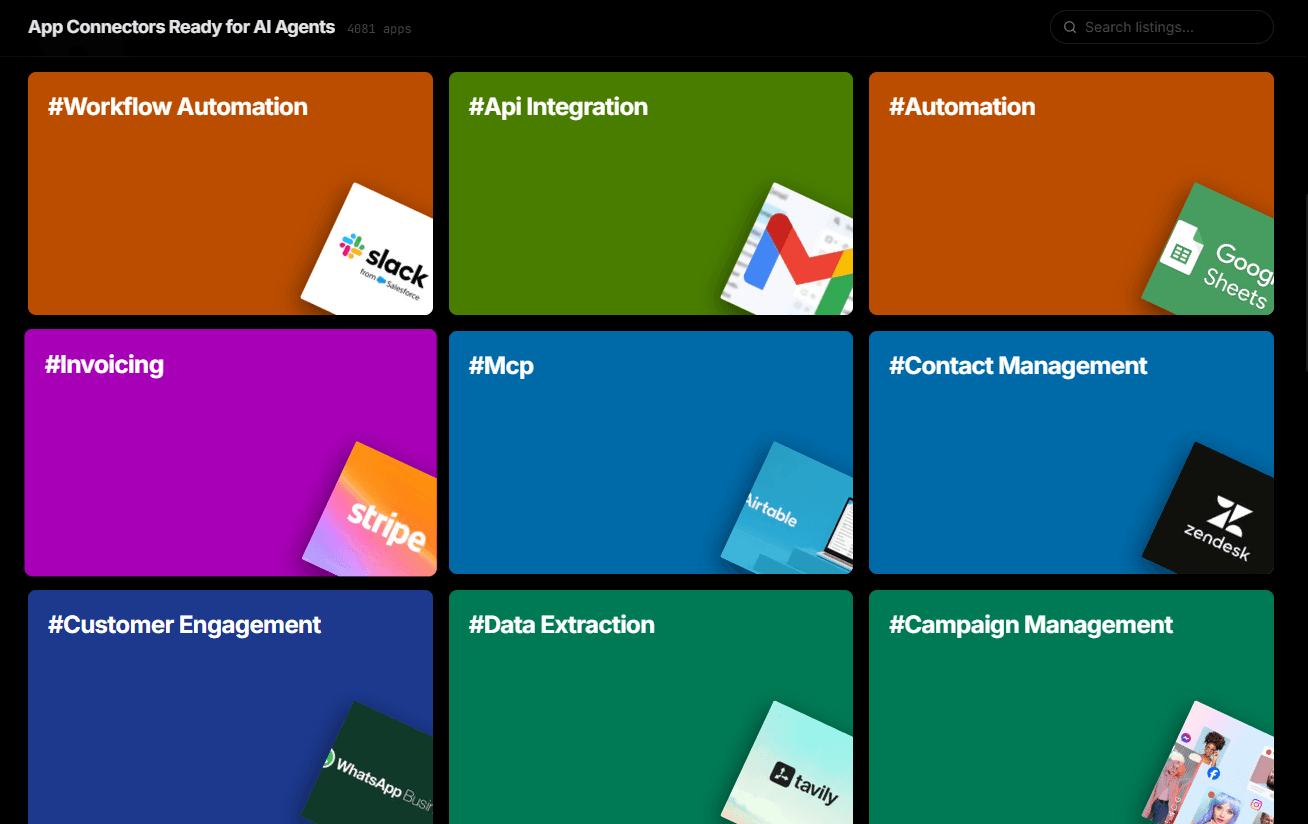
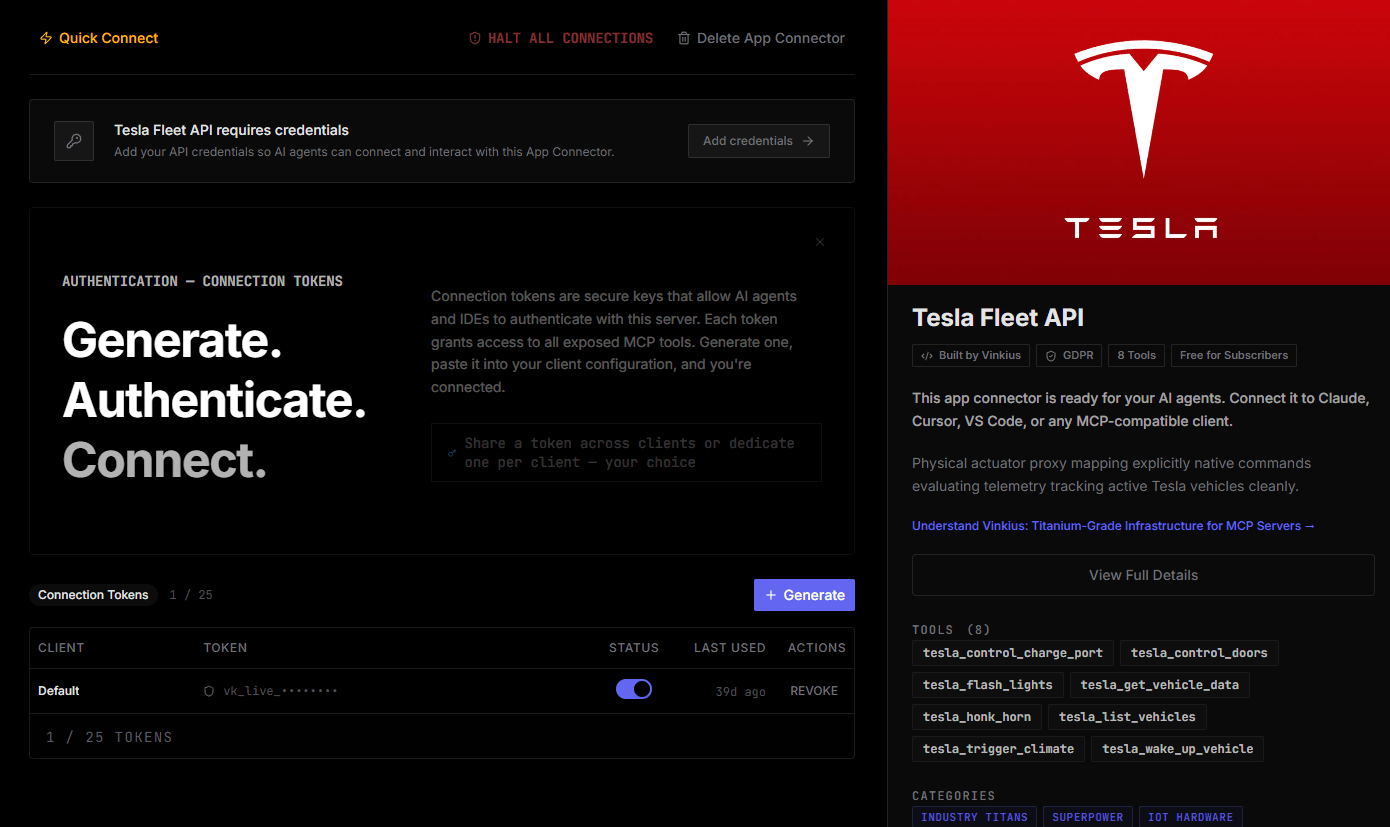
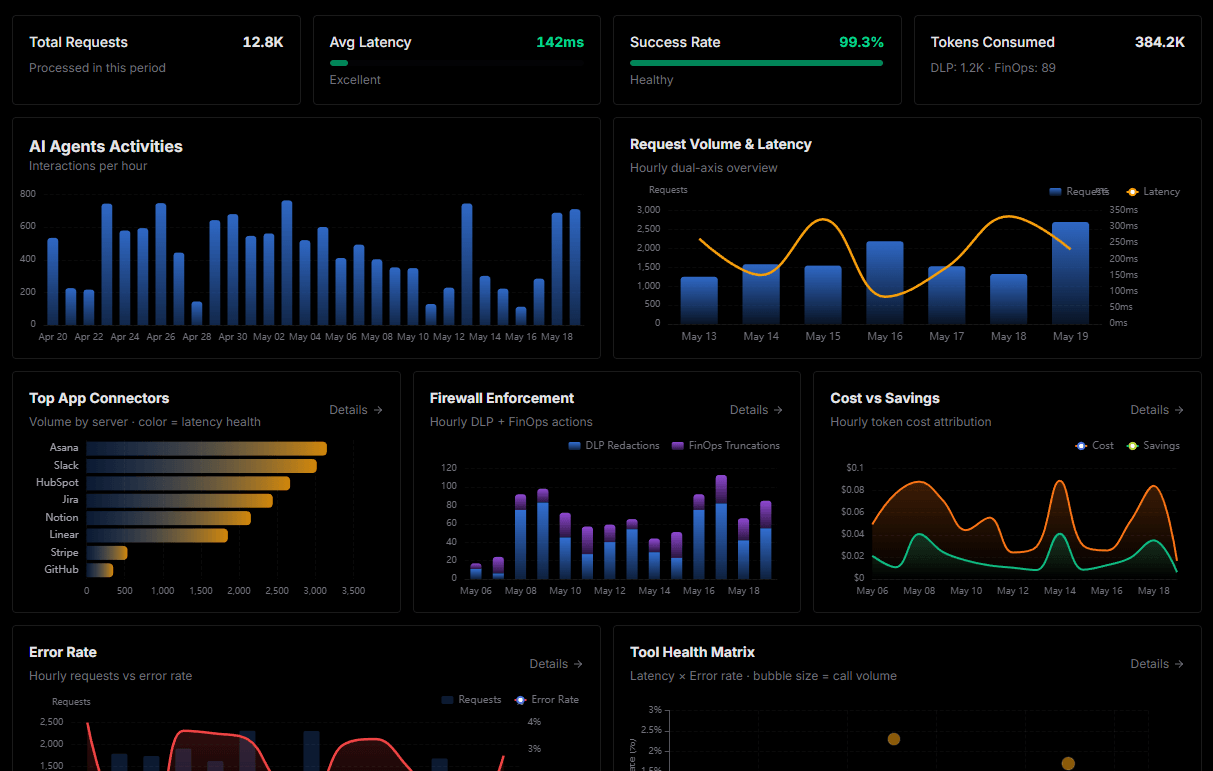
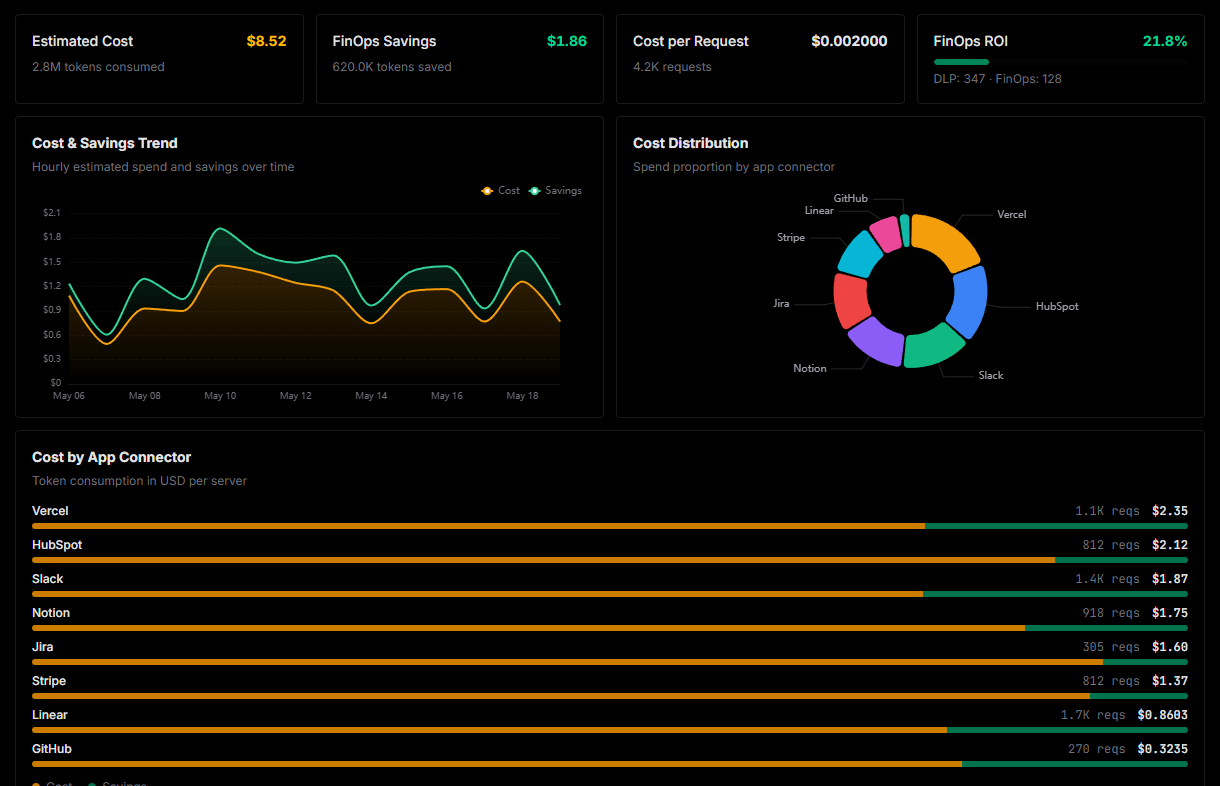
Explore our live AI Agents Analytics dashboard to see it all working
This dashboard is included when you connect Planet Labs using Vinkius. You will never be left in the dark about what your AI agents are doing with your tools.
Planet Labs and 4,000+ other AI tools. No hosting, no code, ready to use.
Professionals who connect Planet Labs to Claude Code through Vinkius don't need to write code, manage servers, or worry about security. Everything is pre-configured, secure, and runs automatically in the background.
Raw MCP | Vinkius | |
|---|---|---|
| Ready-to-use MCPs | Find and configure each manually | 4,000+ MCPs ready to use |
| Connection Setup | Manual coding & server setup | 1-click instant connection |
| Server Hosting | You host it yourself (needs 24/7 uptime) | 100% hosted & managed by Vinkius |
| Security & Privacy | Stored in plaintext config files | Bank-grade encrypted vault |
| Activity Visibility | Blind execution (no logs or tracking) | Live dashboard with real-time logs |
| Cost Control | Runaway AI token spend risk | Automatic budget limits |
| Revoking Access | Must delete files or code to stop | 1-click disconnect button |
How Vinkius secures
Planet Labs for Claude Code
Every request between Claude Code and Planet Labs is protected by our secure gateway. We automatically keep your sensitive data private, prevent unauthorized access, and let you disconnect instantly at any time.
Frequently asked questions
Can my AI search for cloud-free satellite imagery over my farm from last month?
Yes! Use the quick_search tool with your farm boundary as GeoJSON geometry, date range for last month, item_types=PSScene, and max_cloud_cover=10 (for 10% or less cloud cover). The search returns all available imagery matching your criteria with acquisition dates, cloud cover percentages, and download URLs for visual and analytic assets. For ongoing monitoring, create a saved search with create_saved_search and execute it regularly with get_search_results.
What is the difference between PSScene, SkySat, and RapidEye imagery?
PSScene (PlanetScope) provides daily global coverage at 3-5m resolution with 200+ satellites, ideal for broad-area monitoring and time-series analysis. SkySat offers sub-meter resolution (0.5-0.9m) with video capability, perfect for detailed inspection of specific sites. RapidEye provides 5m resolution with a 5-band sensor (including red-edge) and a deep historical archive dating back to 2009. Use list_item_types to see all available imagery types and their supported asset types.
How do I set up automated daily imagery delivery for my area of interest?
Use the create_subscription tool with your area geometry, item types (e.g., PSScene), and cloud cover filter. You can specify delivery to AWS S3, Google Cloud Storage, Azure Blob, or webhook endpoints. The subscription will continuously deliver new imagery matching your criteria as it becomes available. To manage existing subscriptions, use list_subscriptions to review and monitor active deliveries.
How do I add an MCP server to Claude Code?
Run claude mcp add <name> --transport http "<url>" in your terminal. Claude Code registers the server and discovers all tools immediately.
Can Claude Code run MCP tools in headless mode?
Yes. Claude Code supports non-interactive execution, making it ideal for scripts, cron jobs, and CI/CD pipelines that need MCP tool access.
How do I list all connected MCP servers?
Run claude mcp in your terminal to see all registered servers and their status, or type /mcp inside an active Claude Code session.
Command not found: claude
Ensure Claude Code is installed globally: npm install -g @anthropic-ai/claude-code
Connection timeout
Check your internet connection and verify the Edge URL is reachable
Explore More MCP Servers
View all →
Notion
12 toolsManage your Notion workspace, databases, and pages via AI.

Pumble
10 toolsBring your AI agent into your Pumble workspace — read channel history, post messages, create channels, and manage team communication seamlessly.

Clipboard History Searcher
1 toolsSearch through your exported clipboard history (Ditto, CopyQ, Maccy) with AI. Find that URL, phone number, or code snippet you copied days ago.

Duolingo
8 toolsTrack language learning progress on Duolingo — view profiles, streaks, XP, leaderboards and dictionary hints.